

The story of how chef, cookbook writer, and avid reader Theresa Carle-Sanders came to discover the Outlander series and the writer Diana Gabaldon is a funny one. As she tells it in her introduction to this cookbook companion to the popular book/TV series, Carle-Sanders was essentially just saying goodbye to a promising but ultimately unsatisfying job in the field of multinational shipping logistics. Putting the stress behind her, taking up yoga, spending her retirement funds, remembering how to breathe deeply, and venturing back into bookstores for the first time in ages, she picked up the Outlander book and was hooked.
Carle-Sanders eventually started a cooking blog that featured recipes based on or inspired by food and scenes in the Outlander series. (Check out all of Carle-Sanders' fiction-inspired theme cookbook projects at her site.) She had gotten Gabaldon's permission for the blog, and with the TV series being in the works, and the growing Outlander fanbase set to jump from book to screens, Carle-Sanders' timing was good.
We know, because we've been carrying the Outlander Kitchen Cookbook since it was published in 2016, and we've seen the way that Outlander fans have extended their love of Jamie and Claire into a love of Scotland. (We also carry the sequel cookbook -- The Outlander New World and Back cookbook, and -- a related spinoff to all things Outlander, the Outlander Cocktails book.)
As Carle-Sanders points out in her introduction, Outlander Kitchen isn't a Scottish cookbook, exactly -- it's an Outlander cookbook, and since that story has both time-travel and physical trans-continental travel, the framework allows for a lot of creative culinary options.
We know our customers will be happy to have a Scotch Eggs recipe. We know from having numerous customers walk in to our shop and ask for them. (We wish we could sell them, but freezing eggs is not a great way to present this dish. We do have the Scottish sausage though.)
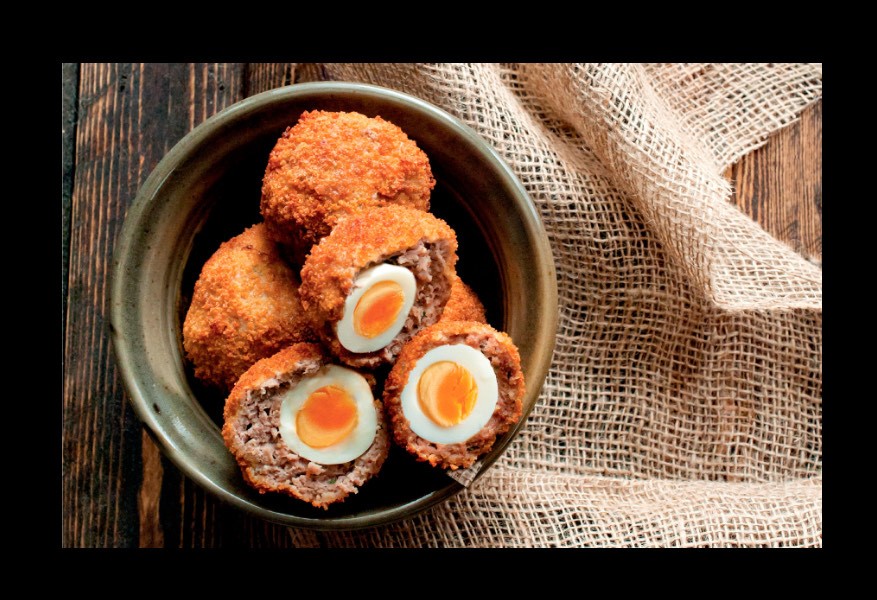
Scotch Eggs (featured with permission from the author)
Theresa Carle-Sanders
6
Scottish
Pork
The origins of this tasty, protein-packed portable snack are unclear. London's Fortnum & Mason claims to have invented it for rich coach travelers in 1738. Others have speculated that Scotch eggs were inspired by nargisi kofta, also known as Narcissus meatballs, a dish of minced meat and boiled eggs from the kitchens of sixteenth-century imperial India. A third, more pedestrian, explanation is the most likely: a portable lunch made from leftovers, a Scotch egg is a variation of a Cornish pasty, bridie, or any other handheld working man's lunch from the early days of industrialized Britain.
Ingredients
- 7 large eggs
- ½ cup all-purpose flour
- ½ teaspoon kosher salt
- Pinch of cayenne pepper
- 1½ cups panko-style breadcrumbs
- 1½ pounds pork sausage
- Vegetable oil
Directions
In a large saucepan, cover 6 eggs with cold water and top off with an extra inch. Bring to a full rolling boil over high heat, remove from the heat, and cover for 7 minutes. Drain and cover the eggs with ice water until cool to the touch, then peel them.
In a small bowl, stir together the flour, salt, and cayenne pepper. In another bowl, beat the remaining egg with 1 teaspoon of water to make an egg wash. Fill a third bowl with the breadcrumbs.
Flatten 4 ounces of sausage into a patty in the palm of your hands, and wrap around a peeled egg. Repeat with the remaining sausage meat and eggs. Roll the sausage-covered eggs in the flour to coat lightly then in the egg wash, and finally in the breadcrumbs to cover evenly.
In a large frying pan, heat 3 inches of vegetable oil to 350˚F. Fry the Scotch eggs until golden, turning occasionally, about 3 minutes. Drain on paper towels. Alternatively, bake in a 400˚F oven until light golden and crispy, 25 to 30 minutes. Serve warm or cold. Store leftovers up to 3 days in the fridge.